

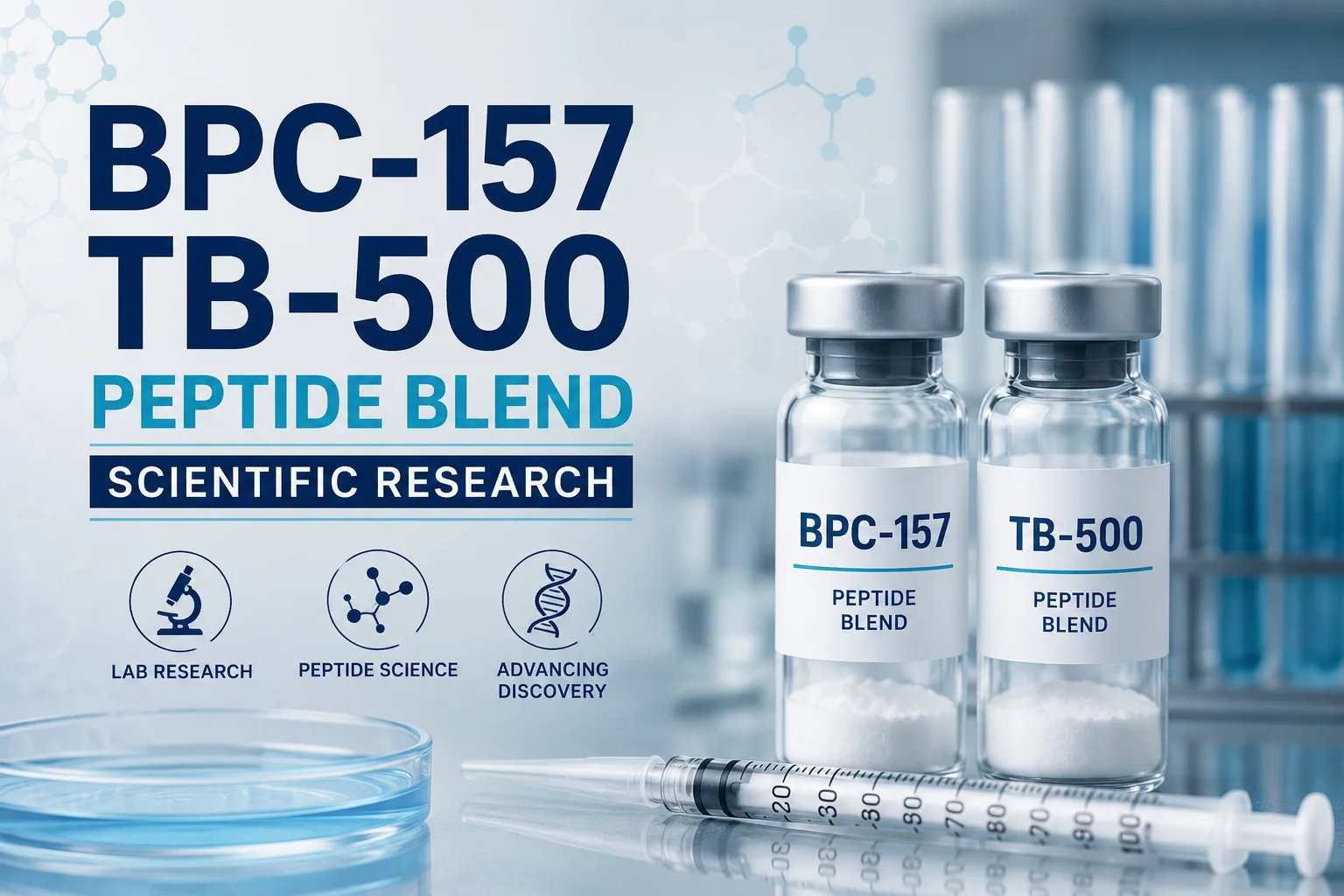
The BPC-157 TB-500 peptide blend scientific research field focuses on the analytical evaluation of two synthetic research compounds within controlled laboratory environments. Researchers may examine this combination to understand peptide stability, molecular characteristics, formulation consistency, and how individual compounds behave when included in a multi-peptide research blend.
A BPC-157 TB-500 peptide blend is generally supplied as a lyophilized laboratory material intended for analytical, biochemical, or non-clinical research. Because both compounds have different structural properties, researchers must consider factors such as purity, identity, storage conditions, batch consistency, and testing documentation before including the blend in an experimental protocol.
This article provides a scientific overview of the blend, its individual components, common analytical methods, handling requirements, and the limitations surrounding current research.
What Is a BPC-157 TB-500 Peptide Blend?
A BPC-157 and TB-500 research blend combines two separately synthesized peptide compounds into a single research formulation. In laboratory settings, this type of combination may be evaluated for:
- Peptide characterization
- Compound identity
- Formulation consistency
- Molecular interaction analysis
- Stability under controlled conditions
- Purity and batch verification
- Analytical method development
The blend should be treated as a research compound rather than a finished therapeutic product. Its purpose is to support controlled scientific research, analytical evaluation, and laboratory-based investigation.
The quality of a research blend depends on several variables, including the accuracy of the formulation, purity of each component, storage history, manufacturing controls, and availability of a detailed Certificate of Analysis.
Understanding BPC-157 in Scientific Research
BPC-157 peptide research generally focuses on the compound’s structure, stability, molecular properties, and behavior in laboratory models. BPC-157 is a synthetic peptide sequence that has been studied primarily in preclinical and experimental research environments.
From an analytical perspective, researchers may evaluate BPC-157 through:
- Amino acid sequence confirmation
- Molecular weight analysis
- High-Performance Liquid Chromatography
- Mass spectrometry
- Solubility assessment
- Degradation monitoring
- Controlled-temperature stability studies
Because BPC-157 remains an investigational compound, laboratory discussions should avoid presenting preclinical findings as confirmed human outcomes. The strongest compliance-based approach is to focus on analytical research, molecular characterization, and verified laboratory data.
Understanding TB-500 in Laboratory Research
TB-500 peptide research commonly involves the study of a synthetic peptide associated with thymosin beta-4-related sequences. Laboratory investigations may examine its molecular characteristics, formulation behavior, purity profile, and stability under different experimental conditions.
Researchers working with TB-500 may evaluate:
- Compound identity
- Molecular composition
- Purity percentage
- Peptide degradation
- Temperature sensitivity
- Sample integrity
- Batch-to-batch consistency
Like BPC-157, TB-500 should be discussed within a non-clinical peptide research framework. Claims relating to treatment, recovery, healing, dosage, or human use should not be included unless they are supported by appropriate regulatory approval and high-quality clinical evidence.
Why Are BPC-157 and TB-500 Combined in Research?
A BPC-157 TB-500 research peptide blend allows researchers to evaluate two peptide compounds within the same formulation. The purpose of combining them in a laboratory product may include studying formulation compatibility, analytical separation, compound stability, and the behavior of each peptide in a mixed sample.
Key areas of investigation may include:
Formulation Compatibility
Researchers may examine whether both compounds remain chemically distinguishable and stable when included in one lyophilized formulation.
Analytical Separation
A multi-compound blend requires accurate methods to identify and quantify each peptide. Researchers may use HPLC analysis or mass spectrometry to confirm that both compounds are present within the expected analytical profile.
Stability Evaluation
The blend may be monitored under controlled storage conditions to determine whether either compound shows signs of degradation, oxidation, aggregation, or reduced integrity.
Batch Consistency
Comparing multiple batches can help researchers assess whether the formulation maintains a consistent identity, purity profile, and composition over time.
BPC-157 TB-500 Peptide Blend Scientific Research Applications
The phrase BPC-157 TB-500 peptide blend scientific research should be used in a non-clinical context. Suitable research areas may include the following.
Peptide Characterization
Researchers may evaluate the physical and chemical properties of the blend, including appearance, solubility, molecular identity, and chromatographic profile.
Molecular Analysis
Analytical laboratories may use instrumentation to confirm molecular weight, sequence-related properties, and the presence of both peptide components.
Peptide Interaction Studies
A peptide combination research project may explore whether the compounds influence one another’s stability, analytical behavior, or degradation profile within the same sample.
Formulation Consistency
Researchers may compare vials or batches to determine whether the ratio and composition remain consistent.
Storage Stability Research
Controlled studies may evaluate how temperature, moisture, light, oxygen exposure, and repeated handling affect peptide stability.
Analytical Method Development
Laboratories may develop or validate methods for identifying, separating, and quantifying each compound in a blended research material.
Important Analytical Testing Methods
Reliable BPC-157 TB-500 analytical research depends on verified testing methods. A product label alone does not confirm compound identity or purity.
High-Performance Liquid Chromatography
High-Performance Liquid Chromatography, commonly called HPLC, is used to separate compounds within a sample. For a peptide blend, HPLC may help identify individual peaks associated with BPC-157, TB-500, and possible impurities.
A detailed HPLC report may include:
- Retention times
- Peak areas
- Purity percentage
- Impurity profile
- Testing date
- Batch identification
Mass Spectrometry
Mass spectrometry may be used for molecular weight confirmation and compound identity testing. This method can help researchers determine whether the detected molecular mass corresponds with the expected peptide structure.
Amino Acid or Sequence Analysis
Sequence-related testing may provide further confirmation that the peptide structure matches the expected synthetic design.
Microbial and Contamination Screening
Depending on the intended laboratory protocol, additional testing may include microbial screening, endotoxin analysis, residual solvent testing, or heavy-metal evaluation.
The Importance of a Certificate of Analysis
A Certificate of Analysis, or COA, is one of the most important quality documents for a research peptide blend. It provides batch-specific information about the material and the tests performed.
A strong COA should ideally include:
- Product name
- Batch or lot number
- Testing date
- Compound identity
- Purity results
- Analytical method
- Laboratory information
- Storage recommendations
- Authorized review or verification
Researchers should review whether the COA is batch-specific rather than a general document reused across multiple products. A reliable batch-level COA supports traceability, laboratory documentation, and quality control.
Purity and Batch Verification
Purity is an important consideration in research-grade BPC-157 TB-500 blend evaluation. However, a stated purity percentage should be supported by transparent testing.
Researchers should consider:
- Whether both compounds were individually identified
- Whether the blend ratio was verified
- Whether purity was measured using a recognized analytical method
- Whether the testing laboratory is independent
- Whether the batch number matches the product
- Whether impurities or degradation products were reported
A high purity claim without supporting data does not provide enough information for controlled scientific work. Third-party laboratory testing, HPLC verification, and accurate batch documentation provide stronger evidence of quality.
Peptide Stability and Degradation Factors
Peptide stability research examines how a compound changes over time under different environmental conditions. Peptides may be affected by:
- Temperature fluctuations
- Moisture exposure
- Direct light
- Repeated freeze-thaw cycles
- Improper laboratory handling
- Contaminated equipment
- Extended storage
- Incompatible solvents
- Oxidation
- Chemical degradation
Because a blend contains more than one compound, researchers should consider whether each peptide has similar or different stability requirements.
Changes in appearance, solubility, chromatographic peaks, or molecular profile may indicate reduced sample integrity.
Storage and Laboratory Handling
A lyophilized BPC-157 TB-500 laboratory research material should be handled according to the supplier’s batch-specific instructions and the requirements of the research protocol.
General laboratory considerations may include:
- Store the sealed lyophilized material at the recommended temperature
- Protect the vial from direct light
- Minimize moisture exposure
- Use clean laboratory equipment
- Avoid unnecessary temperature cycling
- Maintain accurate inventory and batch records
- Label all prepared samples clearly
- Follow institutional laboratory safety procedures
Many research peptides are stored under frozen conditions, often around −20°C, although the correct storage requirement should always be confirmed through product documentation.
Researchers should not assume that all peptide blends have identical storage conditions.
Lyophilized Peptide Formulation
A lyophilized peptide has undergone freeze-drying to remove water from the formulation. This process may support longer-term stability compared with a peptide kept in solution.
The appearance of a lyophilized research material can vary depending on:
- Formulation composition
- Excipients
- Freeze-drying process
- Peptide concentration
- Residual moisture
- Storage history
Visual appearance alone cannot confirm purity or identity. Analytical testing remains necessary.
Research Quality Standards
A dependable research peptide formulation should be supported by documented quality controls. Researchers may look for:
- Verified raw materials
- Controlled synthesis procedures
- Identity confirmation
- Purity testing
- Batch traceability
- Documented storage conditions
- Independent analytical verification
- Accurate product labeling
- Clear research-use restrictions
The phrase research grade should not be treated as a complete quality guarantee. Researchers should review the actual analytical data behind the claim.
Limitations of Current BPC-157 and TB-500 Research
Current discussions surrounding BPC-157 and TB-500 frequently rely on preclinical studies, experimental models, laboratory observations, and limited non-clinical evidence.
Important limitations include:
- A lack of broad, high-quality human clinical evidence
- Limited standardized research protocols
- Variability between study designs
- Differences in peptide synthesis and purity
- Inconsistent product documentation
- Limited long-term stability data for blended formulations
- Difficulty comparing results across laboratories
These limitations make it important to avoid overstating conclusions. Preclinical findings do not automatically demonstrate safety, effectiveness, or approved use in humans.
A scientifically responsible blog should clearly distinguish between laboratory findings, experimental observations, and clinically established evidence.
How to Evaluate a BPC-157 TB-500 Research Blend
Before selecting a material for laboratory analysis, researchers may review the following information:
- Is there a batch-specific Certificate of Analysis?
- Was identity confirmed using mass spectrometry or another validated method?
- Is the purity claim supported by HPLC analysis?
- Does the batch number match the vial and COA?
- Are storage conditions clearly provided?
- Is the blend intended only for laboratory use?
- Is third-party testing available?
- Are both compounds listed separately in the analytical documentation?
- Is the blend ratio clearly stated?
- Are research limitations and handling requirements disclosed?
These factors support more informed decisions when comparing research peptide suppliers and laboratory materials.
Compliance Considerations for Research Peptide Content
Content discussing a BPC-157 and TB-500 research blend should remain objective and avoid unsupported medical claims.
Appropriate terminology includes:
- Scientific research compound
- Laboratory research
- Analytical testing
- Non-clinical research
- Peptide characterization
- Research use only
- Molecular analysis
- Batch verification
Terms involving treatment, injury recovery, pain reduction, therapeutic outcomes, dosage, injections, or human use can create scientific and compliance concerns.
The safest approach is to discuss the blend through the lens of chemistry, analysis, formulation, stability, quality control, and research limitations.
Conclusion
The BPC-157 TB-500 peptide blend scientific research field involves the controlled laboratory evaluation of two synthetic peptide compounds within a combined formulation. Important areas of study include peptide characterization, molecular analysis, HPLC verification, formulation consistency, purity assessment, storage stability, and batch-level quality control.
Researchers should rely on transparent documentation, independent testing, proper storage conditions, and validated analytical methods when evaluating a BPC-157 TB-500 research peptide blend.
Because current evidence remains primarily experimental and non-clinical, discussions should avoid medical or therapeutic claims. A responsible scientific approach focuses on measurable laboratory data, research limitations, and documented compound quality.
Research Use Disclaimer: BPC-157 and TB-500 peptide blends are intended for laboratory research use only. They are not intended for human or veterinary use, diagnosis, treatment, prevention, or consumption.